
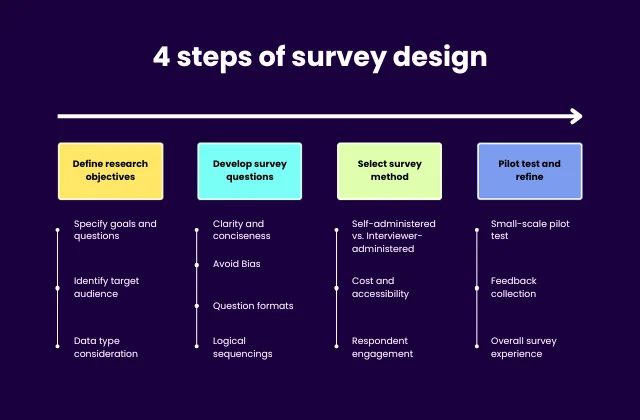
Jakarta, studyinca.ac.id – Collecting data through surveys can be one of the most accessible and effective research methods for university students. It allows them to gather opinions, behaviors, experiences, or factual information from a specific group in a structured way. But the usefulness of a survey depends heavily on how well it is designed. That is why Survey Design is such an important part of student research. A strong survey does more than ask questions. It helps students collect reliable data, reduce confusion, and improve the overall quality of their academic project. When done carefully, survey design can turn a simple questionnaire into a credible research tool.
Why Survey Design Matters
Survey Design matters because poor questions often lead to poor data. If a survey is unclear, biased, too long, or poorly organized, respondents may misunderstand the questions, lose interest, or provide answers that do not accurately reflect their views. In research, this creates a serious problem because even a large number of responses cannot fully fix weak question design.
This becomes especially important for university students because they often work with limited time, limited access to respondents, and limited chances to repeat data collection. A well-designed survey increases the likelihood that each response will be useful, consistent, and relevant to the research objective.
There is also a strong connection to questionnaire writing, research validity, data reliability, respondent engagement, academic methodology, sampling awareness, ethical research practice, and student data collection here. A strong understanding of Survey Design is not simply about making a list of questions. It is about creating a research instrument that gathers meaningful and trustworthy information.
My Perspective on Writing Better Surveys
What changed my understanding of Survey Design was realizing that the hardest part is often not the analysis at the end, but the choices made at the beginning. At first, some may think survey creation is mostly a matter of typing questions into a form. But over time, it becomes clear that every detail matters: wording, order, answer options, length, and even the tone of the survey. If the design is weak, the data may politely look useful while secretly causing trouble later. Research has a sense of humor like that.
That is what makes this topic meaningful. Survey design is not only a technical step. It is also the foundation of data quality.
Core Elements of Good Survey Design
The value of Survey Design becomes clearer when its most important components are broken down directly.
Clear research purpose
Each question should connect to the main research objective.
Simple and precise wording
Questions should be easy to understand and free from unnecessary complexity.
Logical question order
A well-structured flow helps respondents move through the survey naturally.
Appropriate answer options
Response choices should be balanced, relevant, and complete.
Reasonable survey length
A shorter and focused survey usually improves completion rates.
Common Mistakes Students Should Avoid
I have noticed that Survey Design becomes less effective when students include questions that create confusion or bias.
Asking double-barreled questions
One question should ask about one idea only.
Using leading language
Questions should not push respondents toward a specific answer.
Including vague terms
Words like often, regular, or good may mean different things to different people.
Making the survey too long
A long survey can reduce attention and response quality.
Forgetting to test the survey
Without a pilot test, mistakes may remain hidden until data collection begins.
Practical Tips for Collecting Reliable Data
I believe Survey Design becomes much stronger when students follow a few careful research habits.
Start with the research objective
Know exactly what information is needed before writing questions.
Use consistent answer scales
If using rating questions, keep the format stable across the survey where possible.
Pilot test with a small group
Testing reveals unclear wording and technical issues early.
Remove unnecessary questions
Every question should serve a real purpose.
Review for ethics and privacy
Respondents should understand how their data will be used and protected.
Below is a simple overview of effective survey design practices:
| Survey Design Area | Why It Matters | Example in Practice |
|---|---|---|
| Clear wording | Reduces misunderstanding | A student replaces complex academic language with simpler phrasing |
| Focused questions | Improves relevance | Each question links directly to a research objective |
| Logical structure | Supports completion | Demographic questions are placed at the end of the survey |
| Balanced answer options | Improves response quality | A rating scale offers a full range from strongly disagree to strongly agree |
| Pilot testing | Finds hidden problems | A small test group identifies unclear instructions before launch |
These examples show that Survey Design is not simply about creating a questionnaire. It is a practical research skill that helps university students collect more reliable, usable, and academically credible data.
Why Survey Design Matters Beyond One Research Project
The importance of Survey Design extends beyond a single assignment or thesis. It also helps students learn how to ask better questions, think more carefully about evidence, and understand how research quality is shaped before analysis even begins. Those habits are useful in academic work, professional research, and decision-making in many fields.
That broader significance is what makes this topic so valuable. Survey design is not only about getting responses. It is also about building a disciplined approach to collecting information responsibly and effectively.
Final Thoughts
For me, Survey Design is one of the most important skills in student research because it determines whether the data collected will truly support the project’s goals. A well-designed survey improves clarity, reliability, and overall research quality while helping students avoid common methodological problems.
That is why it matters so much. Survey Design is not simply a questionnaire task. It is a foundational research practice that helps university students collect reliable data with greater confidence and accuracy.
Explore our “”Knowledge“” category for more insightful content!
Don't forget to check out our previous article: Study Flashcards: Faster Memorization Techniques Using Smart Flashcard Methods
